Fast-evolving gene is key player in brain development
-

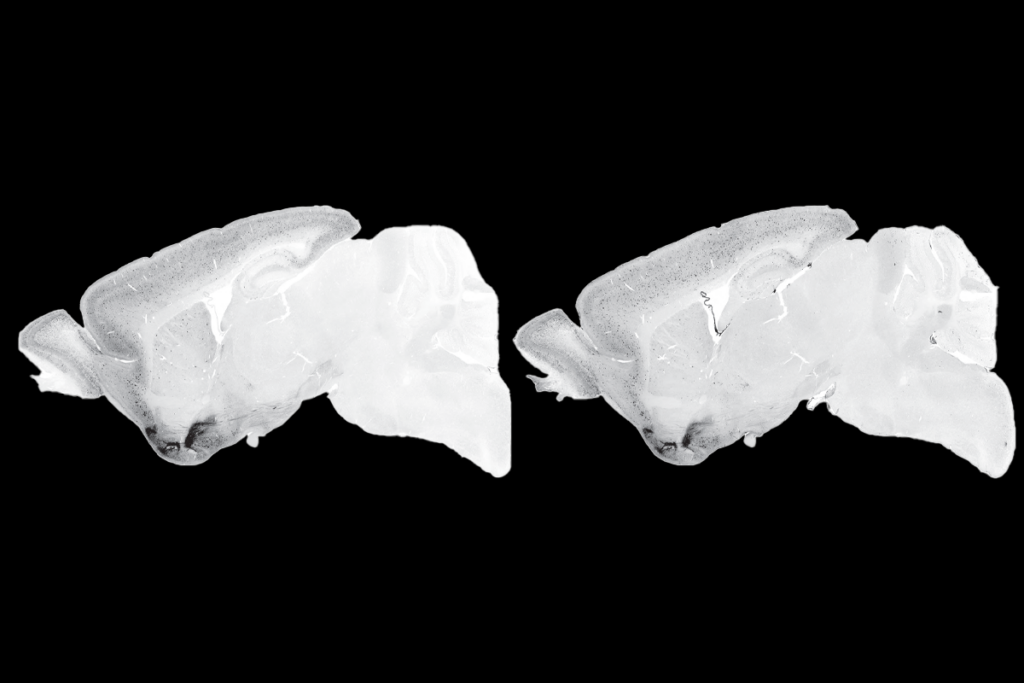
Knocked down: Zebrafish lacking AUTS2 (right), a gene linked to autism, have fewer neurons in the mid-brain region compared with controls (left).
A gene that changed rapidly after the human genome diverged from that of Neanderthals plays a critical role in brain development, according to unpublished results presented Thursday at the International Congress of Human Genetics in Montreal, Canada.
Neanderthals are the closest evolutionary relatives of present-day humans.
In 2001, researchers first identified mutations in the gene, autism susceptibility candidate 2 or AUTS2, which is located on chromosome 7, in a pair of identical twins with autism1.
Since then, AUTS2 has also been linked to attention deficit hyperactivity disorder, epilepsy and mental retardation.
A mouse study last year reported that AUTS2 is expressed at high levels in developing neurons of certain brain regions, notably the frontal cortex and cerebellum2.
Last year, a study published in Science pinpointed the gene as containing a genomic sequence that differentiated humans from Neanderthals early in human history3.
Still, the function of AUTS2 has remained elusive until now.
Researchers at the University of California, San Francisco presented the first functional study of the gene, which they identified while searching for genes important in development.
“We were looking for regions in the genome that have a lot of evolutionary conservation, which usually indicates an important developmental gene that needs tight regulation,” says lead investigator Nadav Ahituv, assistant professor of bioengineering and therapeutic sciences at the University of California, San Francisco.
Ahituv’s team began characterizing the function of AUTS2 before the Neanderthal genome study came out last year. The prominence of AUTS2 as a fast-evolving gene in that study added excitement to the team’s efforts to illuminate the gene’s function.
“We were on a fishing expedition and we caught a big fish,” says Ahituv.
Fish tale:
In the new study, the researchers used morpholinos — molecules that prevent translation of particular RNA sequences — to block expression of AUTS2 in zebrafish. Loss of AUTS2 leads to fish with smaller heads, smaller eyes, fewer neurons in the midbrain region and deficits in motor neurons.
Normally, zebrafish quickly swim away when prodded, but those lacking AUTS2 move sluggishly, if at all. Inserting the RNA for human AUTS2 into the mutants corrects these defects.
The researchers then went looking for enhancers — short regions of DNA that regulate gene expression — in the region of AUTS2 that differs between humans and Neanderthals.
They focused on the first half of the AUTS2 gene, which contains a stretch of nearly 300 single nucleotide polymorphisms (SNPs), variations of a single nucleotide, between the genome of Neanderthals and that of humans.
They also looked for enhancers in ‘human accelerated regions’ of the gene, which are conserved throughout vertebrate evolution, but have radically changed since humans and chimpanzees split from their common ancestor between 5 to 7 million years ago.
Finally, they honed in on enhancers in intron 4, a region of AUTS2 that does not code for protein, and which a previous study had found to be deleted in an individual with autism4.
Using a zebrafish cell line, the researchers identified 21 nucleotide sequences that appear to regulate AUTS2 expression in the central nervous system, and 10 that enhance expression in the brain.
Several of these sequences also regulate central nervous system structure and function in mice, the researchers found. The zebrafish and mouse studies together indicate that AUTS2 serves an important purpose in neurodevelopment, the researchers say.
The researchers plan to check whether deletions of the gene found in individuals with autism are in enhancer regions. “We could then test the enhancer with the mutations that an individual might have, and see if that affects enhancer activity,” says Nir Oksensberg, a graduate student in Ahituv’s lab who presented the results at the conference.
Although the enhancers tested thus far are all within the gene, it is possible that other enhancers lie outside its boundaries, says Ahituv.
These results are intriguing, says Janine LaSalle, professor of medical microbiology and immunology at the University of California, Davis, who is not involved with the study.
“I’m fascinated by the Neanderthal stuff,” LaSalle says. Sequences selected for late in evolution like the ones in AUTS2 would have been advantageous for our ancestors, she notes. “It’s got to have a reproductive or survival advantage in order to be selected.”
LaSalle’s work has shown that AUTS2 is highly methylated in the brain. Methylation involves the addition of a methyl group, which tweaks gene expression without altering the genetic sequence.
None of the SNPs in the new study are in protein-coding regions, La Salle notes. “It’s possible that more recently evolved changes to the genome are regulatory in nature.”
References:
1: Sultana R. et al. Genomics 80, 129-134 (2002) PubMed
2: Bedogni F. et al Gene Expr. Patterns 10, 9-15 (2010) PubMed
3: Green R.E. et al. Science 328, 710-722 (2010) Article
4: Pinto D. et al. Nature466, 368-372 (2010) PubMed
Comments
A nice story on an interesting talk that I also attended. It should be noted that several other posters and platform presentations at the ICHG reported newly identified mutations in AUTS2 in individuals on the autism spectrum. These data strengthen the case that variants in or around AUTS2 really do confer increased risk of ASD.
I might venture a guess that with our slightly smaller and possibly more diverse brains (from hunting to foraging) came an advantage of energy expenditure and/or the increase in more efficient forms of energy dense food (from cooking meat, shore-based diets, fats, refinement of grains) all contributed to that evolutionary jump.... and the development of communities with specialized skill sets (and better coordination)--- some of this is described in the documentary - guns, germs and steel. And of course we know that with diversity and divisions of labor comes diversity of brain structures and other neurobiological correlates., which may come with susceptibilities to messing with those nutritional resources (which is sometimes hypothesized for Neanderthal die-out)
So of course I wonder how much nutrition, if it was part of the process, when it is interrupted or unbalanced, how much that might hinder development...
They seemed to be disadvantages in the energy consumption for the Neanderthals which we corrected with smaller guts, energy-giving food sources and smaller, but more effective brains....
http://newswatch.nationalgeographic.com/2008/09/09/neanderthal/
Growing large brains at a fast pace is an energy-intensive process, which can only be sustained by large, late-maturing mothers.”Compared to modern humans, it thus appears that Neanderthals had somewhat slower life histories,”
Meat-based diet made us smarter?
http://www.npr.org/templates/story/story.php?storyId=128849908
It wasn't a very high-calorie diet, so to get the energy you needed, you had to eat a lot and have a big gut to digest it all. But having a big gut has its drawbacks. "You can't have a large brain and big guts at the same time," explains Leslie Aiello, an anthropologist and director of the Wenner-Gren Foundation in New York City, which funds research on evolution. Digestion, she says, was the energy-hog of our primate ancestor's body. The brain was the poor stepsister who got the leftovers. "What we think is that this dietary change around 2.3 million years ago was one of the major significant factors in the evolution of our own species," Aiello says.
And then of course, with lack of nutrition, comes the brain trying to reorganize to re-adapt and recover from this stress... and I believe that would have something to do with causing a flux in the balance of GABA and glutamate?
http://www.ncbi.nlm.nih.gov/pmc/articles/PMC2818569/
The overall picture of the cortical defects displayed in ASD suggests that glutamatergic and GABAergic tones play a pivotal role. Current hypotheses suggest that autism may be a hypoglutamatergic disorder (Purcell, 2001; Jamain, 2002; Serajee, 2003); conversely, a decreased level of inhibition has also been hypothesized (Rubenstein, 2003; Belmonte, 2004). These observations leave open the possibility for a more complex hypothesis in which different brain regions display unbalanced glutamatergic and GABAergic activity ratios (Polleux, 2005). Accordingly, perturbed Auts2 expression might, at least in part, contribute to the wide heterogeneity of the phenotypes displayed in autism. Future studies will focus on examining the functional role of Auts2 in neuronal development.
Remaining consistent with diathesis-stress hypothesis
http://www.ncbi.nlm.nih.gov/pmc/articles/PMC2427301/
Just saying... and fyi this little box for responses and comments are tough btw, so I hope not too many errors there. :)!
~Lori
As the article states, variants in AUTS2 is associated with risk for autism, ADHD, mental retardation and epilepsy. AUTS2 is also associated with risk for alcohol dependance (Treutlein et al 2009) and bi-polar disorder. (Hamshire et al 2009). AUTS2 may be an autism risk factor of small effect. This is consistent with a complex multifactorial disorder with many layers of complexity. Autism risk factors of small effect are also associated with unfavorable events in the pre, peri and neonatal period, maternal infections, immune deficiencies, preterm and low birth weight deliveries, metabolic disorders, genetic syndromes, neonatal seizures, congenital syndromes with a massive environmental effect (Thalidomide Embryopathy) and exposure to environmental pathogens including alcohol.
The risk factors of small effect, including variants in AUTS2 independently may represent autism risk and when multiple risk factors of small effect are present in aggregate it increases the total autism risk. A confounder is that none of the autism risk factors of small effect are specific to autism but rather represent risk factors for a broad spectrum of neurodevelopmental and neuropsychiatric conditions with or without co-occurring autism.
References
Hamshire, Green et al 2009. Br J Psychiatry Jul;195(1):23-9
http://www.ncbi.nlm.nih.gov/pubmed/19567891
Treutlein et al 2009. Arch Gen Psychiatry Jul;66(7):773-84.
http://www.ncbi.nlm.nih.gov/pubmed/19581569
The correct link between AUTS2 and alcohol dependance is:
http://www.ncbi.nlm.nih.gov/pubmed/21471458
Autism: The Eusocial Hominid Hypothesis
Abstract:
ASDs (autism spectrum disorders) are hypothesized as one of many adaptive human cognitive variations that have been maintained in modern populations via multiple genetic and epigenetic mechanisms. Introgression from “archaic” hominids (adapted for less demanding social environments) is conjectured as the source of initial intraspecific heterogeneity because strict inclusive fitness does not adequately model the evolution of distinct, copy-number sensitive phenotypes within a freely reproducing population.
Evidence is given of divergent encephalization and brain organization in the Neanderthal (including a ~1520 cc cranial capacity, larger than that of modern humans) to explain the origin of the autism subgroup characterized by abnormal brain growth.
Autism and immune dysfunction are frequently comorbid. This supports an admixture model in light of the recent discovery that MHC alleles (genes linked to immune function, mate selection, neuronal “pruning,” etc.) found in most modern human populations come from “archaic” hominids.
Mitochondrial dysfunction, differential fetal androgen exposure, lung abnormalities, and hypomethylation/CNV due to hybridization are also presented as evidence.
http://goo.gl/aloZI