- Info
2012
-
Microscope reveals nanoscale detail in live mouse brains
-
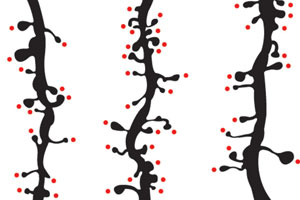
A new microscope allows researchers to capture the movement of tiny signal-receiving branches in the brains of adult mice at the nanoscale level. The results were published 3 February in Science.
-
New technique charts patterns of microRNA expression
-
Researchers have mapped the levels of tiny RNA fragments that regulate gene expression in specific brain regions and subtypes of neurons. The results were published 12 January in Neuron.
-
New machine takes rapid, reliable pictures of brains
-
An automated instrument can reconstruct fluorescently labeled mouse brains in less than a day, researchers reported 15 January in Nature Methods.
-
Brain atlas maps gene expression across development
-
Researchers have charted the expression of more than 15,000 brain genes across 15 stages of development, spanning from 4 weeks post-conception to more than 60 years of age, they reported 27 October in Nature.
-
Video technique measures monkeys' social interest
-
Male rhesus macaques show more interest in videos with social content, such as another monkey displaying aggression, than in videos of landscapes or other animals, according to a study published 26 October in PLoS One.
-
New resource compiles data on autism-linked genes
-
A new online database provides searchable information for nearly 10,000 genes, variants and chromosomal regions linked to autism. Researchers describe the resource, dubbed AutismKB, in the January issue of Nucleic Acids Research.
-
Researchers chart 3D structure of fruit fly chromosomes
-
A new study reveals the three-dimensional structure of fruit fly chromosomes, which groups together active and inactive genes. The results were published 3 February in Cell.
-
Study charts methylation patterns in developing brain
-
Researchers have charted patterns of DNA methylation — a chemical alteration to DNA that modifies gene expression — in the planning center of the brain from before birth to old age. The results were published 10 February in The American Journal of Human Genetics.
-
MRI devices for children reduce head motion in scanner
-
Researchers have developed functional magnetic imaging devices that are optimized to fit children’s heads, according to a study published in the December issue of Magnetic Resonance in Medicine. These tools increase the quality of the data and deter head motion, which research suggests can lead to spurious results.
-
Fruit fly reference helps link genes to traits
-
Researchers have generated and sequenced almost 200 different strains of fruit flies, a widely used model organism, according to a study published 8 February in Nature. The resource they created, called the Drosophila Genetic Reference Panel, will enable researchers to link genetic variants with aspects of fly biology and behavior.
-
Autism mutations lead to scores of symptoms in rodents
-
Mutations in more than 100 autism-associated genes lead to shared neurobiological deficits in mice, including alterations in the shape of their brains and changes to the electrical properties of neurons, according to a study published 20 February in Molecular Autism.
-
Online tool can predict effects of genetic variants
-
Researchers have developed a tool that can predict whether DNA mutations that change a single base pair are likely to alter RNA splicing, a process that modifies the sequence of mRNA, the genetic message that codes for protein. The results were published 10 February in Bioinformatics.
-
Researchers make neurons from blood cells
-
Researchers have generated neurons from the blood cells of individuals with autism, according to a study published 7 March in Neuroscience Letters.
-
Researchers map gene expression in the monkey brain
-
Researchers have used gene expression data to create a map of the layers within the neocortex, a brain region involved in sensory perception, motor control and language, of rhesus macaques. The results were published 22 March in Neuron.
-
Software profiles social interactions between mice
-
A computerized video analysis tool can simultaneously track two mice and catalog their social interactions. The results were published 4 March Nature Methods.
-
Chili pepper protein can alter behavior of mice
-
By manipulating the location of a protein that detects capsaicin, the molecule responsible for the burn in hot chili peppers, researchers can activate subpopulations of neurons and alter the behavior of mice. The results were published 20 March in Nature Communications.
-
Researchers engineer mice lacking microRNAs
-
Researchers are developing a resource that will allow scientists to engineer mice lacking one of 162 microRNAs — non-coding regions of the genome that regulate gene expression. The results were published 19 April in Cell Reports.
-
Blood biomarkers can help diagnose schizophrenia
-
A biological signature in the blood could be used to aid the early diagnosis of schizophrenia, according to a study published 12 April in Molecular Psychiatry. The results suggest that various circulating immune molecules and metabolites reflect the biological changes that underlie neurological disorders.
-
Sponges made from RNA can knock down gene expression
-
Researchers have created sponge-like assemblies of hundreds of thousands of short fragments of RNA, which can be used to dampen the expression of certain genes, according to a study published 26 February in Nature Materials.
-
New technique helps locate source of brain imaging signals
-
Combining functional magnetic resonance imaging of rat brains with a technique that uses light to detect neuronal activity can help researchers hone in on the source of the activity, according to a study published 6 May in Nature Methods.
|
|